...you might be interested in Golan Levin's slitscan video project repository. some very very cool experiments with "video cubism'" type work - http://www.flong.com/writings/lists/list_slit_scan.html (he also has lists of eyetracking and image averaging artwork at http://www.flong.com/writings/lists/)
"Slit-Scan imaging techniques are used to create static images of time-based phenomena. In traditional film photograhy, slit-scan images are created by exposing film as it slides past a slit-shaped aperture. In the digital realm, thin slices are extracted from a sequence of video frames, and concatenated into a new image."
Wednesday, June 08, 2005
Slit Scan
Michelle from Chaise Magazine writes:


New Scientist - Card trick holds promise for movie effects
A bunch of people sent in links to the Dual Photography site, but it seemed a little too tech-y to post yet. Today NewScientist has a shorter summary of what it is and what it means for the effects industry. The basic idea is that they hit an object with light from a projector and take a digital photo from a different angle, and then are able to extrapolate an image of the view from the projector just from the reflected light. It's a neat trick, but the New Scientist article adds,
Eventually, dual photography could be used to alter lighting after a movie scene has been filmed or to add photorealistic virtual objects and characters that cast realistic shadows in post-production.
Tuesday, June 07, 2005
USATODAY.com - $29.95 disposable video cameras
Sunday, June 05, 2005
Lenses...
Bohus Blahut (BOH-hoosh BLAH-hoot), the director of one of Tree Wave's videos, writes:
Anybody else having trouble posting comments? I'll check on it... -W
I've tried posting on the blog under the name "Gulag Picture Radio" BTW, and while I'm all registered and everything I don't see any of my posts anywhere. Just thought I'd mention that.
Anybody else having trouble posting comments? I'll check on it... -W
A few items that I've used in front of the camera are as follows:
Anamorphic lens taken from a WWII gun camera (?). It weighs around 20 pounds and has a mount unlike anything I've ever seen - it's about 6-8" across. Needless to say I never actually mounted it to the camera, instead holding it. I also seem to remember devising some sort of mount on a mic stand. I've used it with several video cameras (Canon L-1 and XL-1 come to mind) and with a Bolex 16mm camera.
Fresnel magnifying sheet originally manufactured as a cheap magnifying glass for older folks. Because it is thin plastic and flexible, you can get a lot of cool distortions that way. I've also seen similar flexi sheets with a bunch of little miniature fresnel patterns on them. They are sometimes used as privacy screens that you paste to your bathroom windows to let light in, but not let anyone see in.
Thin (but stiff) mylar squares - often used as mirrors in kids toys or books. Mount this in front of your camera at a 45 degree angle, then shoot your subject with the camera pointed sideways in relation to them. Flex the mirror for weird effects, remembering to flip the picture orientation in your editing software. The BBC used to use this effect for Doctor Who for when the Ice Warriors shot anyone. They used something called "Mirrorlon" which I would expect to be much thinner than the mirror I'm talking about which would give you some nice ripply distortion.
I've also used a lot of still photography filters with video cameras. Here in Chicago there are massive photography swap meets where you can get tons of special effects filters for next to nothing. Many of them can be useful for video. I've used a star filter, fly's eye filter (image in middle surrounded by 5 identical images, and filter can rotate - great for 60's pop singer look), polarizing filter (great for cutting glare when shooting through a window, or for making a car look less scratched up), center focus, some gradiated filters for dramatic skies...
The problem is that with my current video cam (the Canon XL-1) the lens is so massive, it's so hard to find filters to fit it at these swap meets. Common filters for still photography are 45-55mm (probably other sizes too), and the XL-1 clocks in at a massive 72mm. You can get adapter step-down rings to compensate, then zoom in a little to avoid vignetting.
There are also some great gadgets that I've used with old film cameras in front of the lens that aren't filters. My Bolex has had an iris attachment (for transition effects), a clock work device for a variety of animated wipes, titling rigs, and my personal favorite... a 3D lens set for shooting 3D films. Before you ask, yes I've shot some 3D footage, but I'm missing one important part of the projector arrangement to see if my experiment worked. :)

Saturday, June 04, 2005
Lenses
A while back I wrote about infrared filter lenses for DV cameras. I'm interested in what other weird lenses are out there- maybe impractical for regular, professional use - but perfect for video projects that are... ahem.. *crunked up*. And don't just say "fish-eye!"
Post in the comments or send us a tip.
Post in the comments or send us a tip.
Thursday, June 02, 2005
kiteCam

VT reader Yair Reshef writes:
been watching your blog and i feel this can be of interest to you. [...]
I shot this footage using a 25 dollar wireless cam i order of eBay. hooked it to a kite and it gave nice results.
i also tried to make low cost diy video/music scratching platform, like this stuff using a broken turntable with a reflective sticker on it, a small securtiy camera and eyesweb for tracking and was able to get some nice results. its still ver. 0.1 but its a proof-of-concept i guess. very responsive. and with several records with different diameters can be used to scratch several different sources! [ link]
Kurt Ralske

VT reader Kurt Ralske sent us some kind words and a link to his portfolio of excellent video art. Pieces include a permanent display at the MOMA that's tied-in with the Museum's visual branding, a collaborative video improv piece made by three different artists, and a visualization generated from live video feeds of zebra fish.
Wednesday, June 01, 2005
Call for links
Do you have a garage video project you're dying to tell someone about? Has the Asperger's syndrome sufferer next door hacked a Commodore 64 to do 3D? Got the scoop on some new HD video microscope? Got a motion graphics project to show off, or saw a great reel we missed?
Send in your video thing tips!
In the meantime, here's a piece from Tom's Hardware Guide on How to build your own XGA video projector for 300 dollars.
Send in your video thing tips!
In the meantime, here's a piece from Tom's Hardware Guide on How to build your own XGA video projector for 300 dollars.
Rtv Visual Entertainment Generator

80 bucks seems a little steep for this, but I can see how it could be handy- the RTV lets you use VGA computer monitors as NTSC monitors, without a computer.
Now you can put an old VGA monitor to good use, or simply get more out of the one that's connected to your PC. The Visual Entertainment Generator, or 'VEG', is a compact external unit that easily turns a VGA monitor into a multimedia center for watching TV or for use as a display for your favorite gaming console.[...]The VEG uses 3:2 pull down correction that eliminates jitter from DVD movies that occurs during the transfer from film. With motion and adaptive de-interlacing, the VEG improves the clarity and sharpness of the picture.
Link
Psyop- Bubbles

Nice new piece of work by PsyOp. Justin at Tween (who is mirroring the clip) says each particle is hand placed, which would certainly make for a lot of painstaking work.
Tuesday, May 31, 2005
Media Sensitive glasses (we-make-money-not-art)
This is a slightly less aggressive take on the TV-B-Gone device: Sunglasses that go black when there is a TV in sight.
Link
As part of her Social Defense Mechanisms: Tools for Reclaiming our Personal Space research, Limor Fried (creator of the Wave Bubble and the Minty MP3) developed the Media-Sensitive Glasses that automatically darken whenever a television is in view, so as to protect the wearer from television's 'hypnotic' effect.
Link
Thursday, May 26, 2005
Setpixel // Shadow Story

Shadow Story allows children to physically play with sketches that they created. Shadow Story is a projection-based interactive installation. Children cast shadows on the wall using their bodies to interact with the elements in the visual projection...
Link
Edirol CG-8 Visual Synthesizer

Why rely on software to generate your cheesy dance-club visuals when you can buy an expensive piece of hardware to do it?
CG-8 Visual Synthesizer
Wednesday, May 25, 2005
Apple - Mac OS X Downloads - Video - Trans Lucy
For people with serious attention deficit disorder:
Link
[Trans Lucy] Allows you to watch DVDs on your computer in a whole new way. The movie display can be floated above all applications and the translucency of the video can be adjusted so you can see through the video and work with documents underneath.
Link
Friday, May 20, 2005
Wednesday, May 18, 2005
SSSSSSLLLLLOOOOOO MMMMMOOOOOO VVVVVIIIDDDDEEEEOOOOOO
Slo/Mo Video: Touring Festival+DVD+Website, Seeking one hundred and twenty slow motion video submissions. Each exactly 1 minute in length. Deadline July 15th, 2005. Fiction and non-fiction, The more crunked up the better.
That sounds like a challenge. I'm game. Nick, didn't you say you just got an AE plugin that will do some kind of motion interpolation that would allow you to do convincing slow motion in already shot video?
Link
Quartz Composer Samples
 Quartz Composer is a developer tool that ships with Mac OS X 10.4 ("Tiger") that allows you to access all the nifty graphical powers of Tiger's CoreImage without having to learn how to program. Fooling around with it I managed to make a couple of screen savers, and I can already see that there's a lot more potentially that could be done with it. Quartz Composer has controller patches for midi input, but what I think would be really nifty is if you could use it to create your own iTunes visualizers. I'd love to see something replace the tie-dyed-vomit visualizer that has been shipping (relatively unchanged) with iTunes since it first came out. It was fine in 1995, but it just doesn't show off what the Mac can do now, it's an embarrassment. The current homebrew visualizers aren't much better.
I want someone to make an Atari Video Music Emulator!
Check out some sample Quartz compositions on this Japanese page: (You'll need to have Tiger/QuickTime 7 installed)
Link
Found Via QuartzComps.com
Tuesday, May 17, 2005
H.264 day three: Demonstrations at HD resolutions
Friday, May 06, 2005
My ghetto 360° video experiment
Inspired by this previous Video Thing post about panoramic video, here's my incredibly lo-fi DIY attempt.
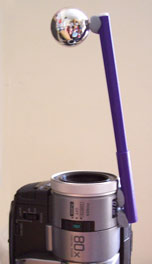
Old plastic Christmas tree bauble I found in the garden the other day
+
Felt tip pen
+
Blu Tak
=
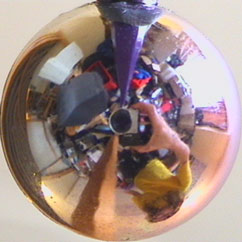
+
"Polar Coordinates" distortion in After Effects
=

1.1mb mpeg4 test clip!
EDIT - now also on Youtube! :)
It's decidedly fuzzy, and my demo isn't exactly spectacular as the camera was tethered to capture card and power supply, (battery dead & couldn't be bothered to find a blank tape) but works much better than I thought it would! Exciting results for such a half-baked attempt.
I'm going to build a more robust and high quality version (ie get a better mirror ball!) some time soon.
Oh, and by the time I took the above photo of my setup it had gone a bit wonkey, but I did have the ball lined up with the lens much better than it looks there!
Old plastic Christmas tree bauble I found in the garden the other day
+
Felt tip pen
+
Blu Tak
=
+
"Polar Coordinates" distortion in After Effects
=
1.1mb mpeg4 test clip!
EDIT - now also on Youtube! :)
It's decidedly fuzzy, and my demo isn't exactly spectacular as the camera was tethered to capture card and power supply, (battery dead & couldn't be bothered to find a blank tape) but works much better than I thought it would! Exciting results for such a half-baked attempt.
I'm going to build a more robust and high quality version (ie get a better mirror ball!) some time soon.
Oh, and by the time I took the above photo of my setup it had gone a bit wonkey, but I did have the ball lined up with the lens much better than it looks there!
Thursday, May 05, 2005
Near-Near Future: Khronos Projector
"The Khronos Projector allows people to visualize movie content in a new way. By actually touching and deforming the screen, the user can send portions of the image forward or backward in time."
Link
Link
Subscribe to:
Posts (Atom)

