Via Make: The MythTV 'homebrew' PVR project has a promising Intel Mac OS X build coming along. More info and background on the project here. Could be very promising on an intel Mac Mini.
 The January/February issue of RES Magazine has an interesting article on how to make 3D videos with a pair of Apple iSights. We'll post a link when the article gets archived, otherwise, grab yourself a copy!

Up for sale is a circuit bent video synth created by Corneilius Brown in 1999. It was originally designed to control the sexual stimulation of large crowds or individuals. It accepts customized slides and projects them onto any video screen. (TVs, video projectors, etc). It also displays colorful geometric shapes that change with the control unit. The two video sources combine to create a very strange phenomenon. [...] I made a website dedicated to Corneilius (no not 'Cornelius') Brown. I put most of the pictures on there because I'm not sure if ebay would accept them or not due to their sexual nature.
PLEASE visit the website as it has more pictures and info...

According to a survey conducted by RBC Capital Markets, about 75 percent of roughly 1,000 people polled said they had no interest in watching TV on their cell phones. And about 70 percent said they didn't see themselves using their cell phones for musical entertainment.


The development of the computer as an animation tool inspired a period of radical innovation in techniques and visual form. By the late 60s, there were a number of film-makers using the new ‘dream machines’ as their medium, often exploring new aesthetics that had no precursor in the history of cinema. This programme (curated by Gregory Kurcewicz) features work by film-makers including Lillian Schwartz, John Stehura and John Whitney, who overcame the constraints of low memory and primitive interfaces to create works of lasting beauty.

The first film festival that celebrates makers and the DIY mindset.
Grab those hacked CVS video cameras and $14 steadycams. It's time for MAKE: Movies! MAKE: is hosting the first festival for makers to show off their DIY short video clips. Don't think of it as a contest, because there isn't much to win if you make the cut... other than the admiration of your peers, a bag of MAKE: goodies, and the chance to see your work on the big (well, medium) screen at the upcoming Maker Faire in April. Our favorite footage will premiere at a special MAKE: Movies! party at the Maker Faire and shown throughout the event. Of course, you're invited to walk down the asphalt carpet and say a few words about your work. After the Faire, the selections will be available for free download on Makezine.com. So charge those batteries, fire up Final Cut, and... Action!
Important: Submit your movie by March 24, 2006!
Democracy Player is a video content aggregator, and it also includes a component named the Broadcast Machine that allows users (budding filmmakers?) to easily set up a distribution channel for their work. It's very intriguing... I could potentially see filmmakers setting up channels to post short films, sample clips, teasers, or production
videos... who knows! Whatever the case, this is a great way to increase exposure.
Democracy Player: http://www.getdemocracy.com/
Broadcast Machine: http://www.getdemocracy.com/broadcast/
Here is a sameple BM page (complete with RSS feed for Democracy) I set
up: http://www.small-scale.net/bm/


Pixar Animation Studios, which is being bought by Disney, is is apparently building more native Mac OS X applications and is seeking programmers with advanced skills in Object-C and Cocoa, according to a post on Highend3D online

Light Blue Optics Ltd (LBO) has developed a revolutionary technology for miniature laser projectors dubbed PVPro(tm). Today they announced their latest demonstrator unit, which is only 3.78 cubic inches in volume, and is similar in size and shape to a typical matchbox. Projectors based on PVPro technology can be used to display images from a range of mobile devices, including laptop computers, personal media players like the video iPod, digital cameras and even mobile phones.

Nam June Paik has died at the age of 74:
If you are video artist and don't know Paik's work, you should. He introduced the world to video art in the 1960's and collaborated with the Fluxus art movement with folks like John Cage and Charlotte Moorman.

MIAMI - Nam June Paik, the avant-garde artist credited with inventing video art in the 1960s by combining multiple TV screens with sculpture, music and live performers, has died. He was 74.
The Korean-born Mr. Paik, who also coined the term ``Electronic Super Highway'' years before the information superhighway was invented, died Sunday night of natural causes at his Miami apartment, according to his Web site.
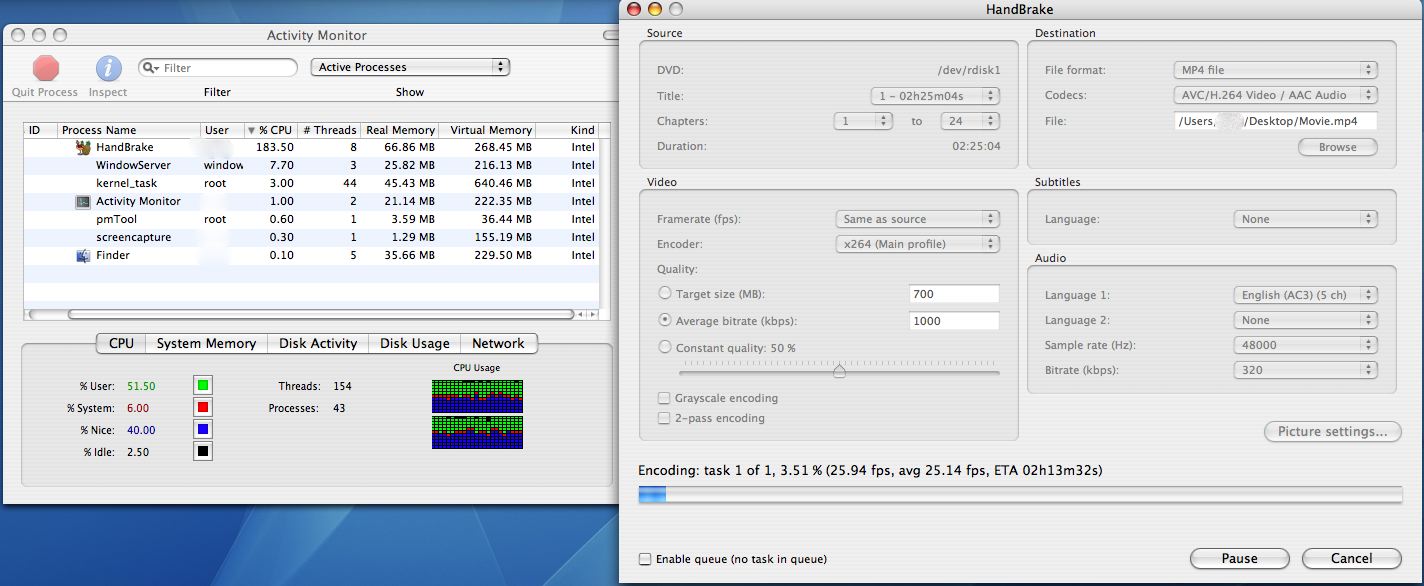
...so I get a lot a emails asking if HandBrake will support the new Intel Macs. The answer is yes, a x86 build is already available from the download page. Not everything is optimized for Intel yet, but H.264 is and a 2.0 Ghz Core Duo iMac reportedly encodes about real-time to H.264 at full size (screenshot). The next release should be available as a Universal Binary and full optimized for both platforms.


...I know it's not ask dr. wiley, but i was wondering-
my friend and i both have canon zr series dvs,
theyd be pretty easy to rig stereoscopically,
does anyone have the software to generate 3D?
with or without glasses?
canons XL1 had a stereo lens, but i think that
just utilized the interlace.
do you know anything about this?
or where i could try looking?

Teletext is a system which encodes extra information in analogue TV signals, where televisions with the right chip can decode and display special text and graphic pages. Teletext originated in the UK in the 1970's. Today teletext services still offer a range of text-based information, usually including national, international and sporting news, weather and TV schedules. There is an excellent Wikipedia page describing teletext and itshistory here.
[...]
This new channel is called Microtel. The station managers are artists Emma Davidson [Lektrogirl] and Paul B. Davis from Lektrolab. Microtel teletext programs will be broadcast by NOS, Netherlands public television.
Microtel is one of the projects curated by ambientTV.net as part of VBI [voluptuous blinking eye] - a submission for the exhibition "Satellite of Love" . This exhibition is presented by the 35th International Film Festival Rotterdam in association with Witte de With Center for Contemporary Art and the TENT Centre for Visual Arts. The exhibition runs from 26 January to 05 February 2006.
Up until 04 February 2006, you will be able to create teletext and email it to Microtel for inclusion on this website, a DVD to be distributed by SCEEN magazine andmost importantly broadcast on Netherlands TV station NOS. Check technical information for software downloads and FAQ's to contribute today!

The government is proposing that devices (consumer electronics, computers, software) manufactured after a certain date respond to a copy-protection signal or watermark in a digital video stream, and pass along that signal when converting the video to analog. The same goes for analog video streams, to pass on the protection to the digital video outputs.
The technology Congress is proposing (VEIL) is derived from one that originated with assorted interactive Batman toys that allowed the toys to respond to Batman television shows or videos. How cool—at least for toys.
The government wants your future TV, TiVo, computer, cell phone, Final Cut Pro, (input your favorite analog signal viewing / converting device here) to respond to the Bat Signal.
The holographic disk promises to retail for $100, and by 2010, it will have capacity of 1.6TB each. That's pretty inexpensive," said Ron Tarasoff, vice president of broadcast technology and engineering at Turner Entertainment. "Even this first version can store 300GB per disk, and it has 160MB/sec. data throughput rates. That's burning. Then combine it with random access, and it's the best of all worlds.
PXL THIS 15, the 15th annual film festival featuring the Fisher Price PXL 2000 toy video camera premieres Saturday, Nov 19, 2 different shows 7 & 9pm at Sponto Gallery, 7 Dudley Ave, Venice, 310-306-7330, free admission. For more info, please visit: www.indiespace.com/pxlthis and www.81x.com/7dudley/cinema


LightSpace claims its DepthCube is the world's first solid-state volumetric 3D display capable of 3-dimensional projections without any headgear or moving parts. The display runs on a stack of 20 liquid crystal shutters synchronized with a video projector (50Hz refresh rate) all packed in a TV set box circa 1980.
As I twist the Play-Doh and take bits away, the film reacts accordingly in real-time. Add too much Play-Doh and the film rapidly speeds up. An intimate connection is made between the user and the media. Every action has a reaction in the digital space. No scary buttons to press. No instructions to read. It's just Play-Doh.
Every week we will feature a different home movie taken from 8mm, super 8, or 16mm film. Every film we share has been shot by amateurs, and many never have been seen by more than a few people.

Newsight Corporation has developed a technique for displaying HDTV in 3D without the need for wearing special glasses.
The technique uses software processing to pass HD video streams through a converter chip that creates eight stereo
views on-the-fly. When a filter is applied to project each of the eight views in a slightly different direction on an
LCD monitor, the human eye picks up the different scenes and composites them into a coherent three-dimensional view.
The Memory Stick Pro recorder is an analog to digital video converter that records movies and TV shows straight to your Memory Stick Pro Duo, for playback on PSP
There is actually a long history of video stored on vinyl. Not too long ago the earliest recordings of some of Britain's earliest broadcasting experiments (done by Baird)on acetate. These were digitized and restored on the internet someplace.
[The video turntable in last post -w] isn't the same (and is wickedly cool I should mention) but I thought that you guys might be interested. Also you might want to check out a current take on similar technology. Hit www.vinylvideo.com to learn more.
Video Turntable, by miyakodub, is a machine that appears to be very similar to a regular turntable. You put a disc on it, the disc rotates, and then the system picks up sound that's encoded on the disc. But Video Turntable uses a webcam instead of a phonograph needle, transparent discs with color patterns instead of traditional black discs with grooves, and a digital computer vision system instead of analog circuits to decode and produce sound.Multiple transparent discs can be stacked, creating different combinations of colors and thereby sound. The system can recognize five colors: black, red, yellow, blue, and green. Depending on which area colors appear in a webcam's view, the system controls pitch, pan, volume, delay, etc. You can also draw color patterns on a disk by yourself and use it to play unique sound patterns.
It's a video thing in the widest sense of the word -
Super 8 film is alive and kicking and we've set up www.onsuper8.org to provide the latest news, views and information for those using the little film but editing digitally. Why not combine those luscious celluloid images with the ease of DV editing? Sounds like the best of both worlds to me!


The Media Mirror is an interactive video installation, in which 200+ channels of live cable television are continuously arranged in real-time to form a mosaic representation of the person that stands in front of it.
It looks like the Hollywood studios are requiring use of an HDMI connector with HDCP (hardware device copy protection) for high definition video content on next generation formats, HD DVD and Blu Ray. [...]
So what does this mean? Imagine you spent $2000-$5000 on an HDTV a couple of years ago. You're into all this new tech, you love it. So HD DVD and Blu Ray discs actually ship, and you plunk down $500-$1000 for one of the first players (assuming you're OK buying into one of two competing standards) and you take it home and pop it in your player. Woops, your set lacks HDMI with HDCP, you only have HD component analog connections. Even though they work with all of your other high definition gear, the player will quietly downsample your HD signal to standard definition. You watch the movie, and frankly, it doesn't look any better than your regular DVDs that play on your kids' $50 player. Box it up and return it, you don't think it's worth it. You could be watching a regular DVD on a $50 player on a $300-$800 TV and it would look pretty much just as good...



Introducing the RGB guitar solo. Viditar is Livid's pioneering custom made video instrument for real-time video expression and performance. Viditar's integrated hardware and software takes video performance away from the computer and onto the stage. Generate high quality real-time video performances by combining video triggering, scratching, source mixing, and live camera manipulation, to give you total control over hundreds of effects and thousands of media files.

Each face of this cubic movie player is a high-resolution and rimless display allowing you to watch digital movie contents in any place where there's Wi-Fi.


The setup is 3 TVs facing the wall attached to 3 Atari 2600 consoles, and the Ataris are programmed to play a repeating sequence of color that lasts about 4 minutes.
Each color is actually made up of two colors that are mixed by displaying one color at the top half of the screen and the other one at the bottom, and the two are swapped at 30Hz. It gives the sense that the colors are flowing. And the refresh frequency for each TV is gently modulated out of sync with the others, which gives the light even more motion.
This piece will be installed at the McKinney Avenue Contemporary in Dallas, June 25th - July 30th.
somewhat related to your recent foray into slow mo stuff - engadget had an
interesting article today:
http://www.engadget.com/entry/1234000043047434/
on this high speed video camera:
http://photron.com/products.cfm?id=KingOfHighSpeedVideo
http://photron.com/gallery/gallery.cfm
Thought you might be interested if you hadn't seen it already.
Really slow site right now though...

[Volumetric Video] The basic idea is simple: Video is composed of a large number of individual frames, each with X and Y dimensions. Just stack each frame on top of the next and you've got a Z dimension to place into a volume renderer.

nice selection of diy optics from a surplus optics store-
http://www.anchoroptics.com/documents/
found via http://www.htservices.com/Tools/MachineVision/index.htm
...you might be interested in Golan Levin's slitscan video project repository. some very very cool experiments with "video cubism'" type work - http://www.flong.com/writings/lists/list_slit_scan.html (he also has lists of eyetracking and image averaging artwork at http://www.flong.com/writings/lists/)
"Slit-Scan imaging techniques are used to create static images of time-based phenomena. In traditional film photograhy, slit-scan images are created by exposing film as it slides past a slit-shaped aperture. In the digital realm, thin slices are extracted from a sequence of video frames, and concatenated into a new image."
Eventually, dual photography could be used to alter lighting after a movie scene has been filmed or to add photorealistic virtual objects and characters that cast realistic shadows in post-production.
I've tried posting on the blog under the name "Gulag Picture Radio" BTW, and while I'm all registered and everything I don't see any of my posts anywhere. Just thought I'd mention that.
A few items that I've used in front of the camera are as follows:
Anamorphic lens taken from a WWII gun camera (?). It weighs around 20 pounds and has a mount unlike anything I've ever seen - it's about 6-8" across. Needless to say I never actually mounted it to the camera, instead holding it. I also seem to remember devising some sort of mount on a mic stand. I've used it with several video cameras (Canon L-1 and XL-1 come to mind) and with a Bolex 16mm camera.
Fresnel magnifying sheet originally manufactured as a cheap magnifying glass for older folks. Because it is thin plastic and flexible, you can get a lot of cool distortions that way. I've also seen similar flexi sheets with a bunch of little miniature fresnel patterns on them. They are sometimes used as privacy screens that you paste to your bathroom windows to let light in, but not let anyone see in.
Thin (but stiff) mylar squares - often used as mirrors in kids toys or books. Mount this in front of your camera at a 45 degree angle, then shoot your subject with the camera pointed sideways in relation to them. Flex the mirror for weird effects, remembering to flip the picture orientation in your editing software. The BBC used to use this effect for Doctor Who for when the Ice Warriors shot anyone. They used something called "Mirrorlon" which I would expect to be much thinner than the mirror I'm talking about which would give you some nice ripply distortion.
I've also used a lot of still photography filters with video cameras. Here in Chicago there are massive photography swap meets where you can get tons of special effects filters for next to nothing. Many of them can be useful for video. I've used a star filter, fly's eye filter (image in middle surrounded by 5 identical images, and filter can rotate - great for 60's pop singer look), polarizing filter (great for cutting glare when shooting through a window, or for making a car look less scratched up), center focus, some gradiated filters for dramatic skies...
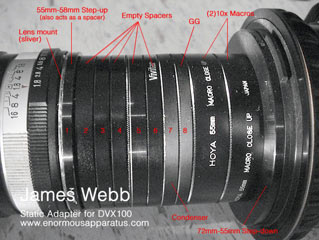
The problem is that with my current video cam (the Canon XL-1) the lens is so massive, it's so hard to find filters to fit it at these swap meets. Common filters for still photography are 45-55mm (probably other sizes too), and the XL-1 clocks in at a massive 72mm. You can get adapter step-down rings to compensate, then zoom in a little to avoid vignetting.
There are also some great gadgets that I've used with old film cameras in front of the lens that aren't filters. My Bolex has had an iris attachment (for transition effects), a clock work device for a variety of animated wipes, titling rigs, and my personal favorite... a 3D lens set for shooting 3D films. Before you ask, yes I've shot some 3D footage, but I'm missing one important part of the projector arrangement to see if my experiment worked. :)

been watching your blog and i feel this can be of interest to you. [...]
I shot this footage using a 25 dollar wireless cam i order of eBay. hooked it to a kite and it gave nice results.
i also tried to make low cost diy video/music scratching platform, like this stuff using a broken turntable with a reflective sticker on it, a small securtiy camera and eyesweb for tracking and was able to get some nice results. its still ver. 0.1 but its a proof-of-concept i guess. very responsive. and with several records with different diameters can be used to scratch several different sources! [ link]


Now you can put an old VGA monitor to good use, or simply get more out of the one that's connected to your PC. The Visual Entertainment Generator, or 'VEG', is a compact external unit that easily turns a VGA monitor into a multimedia center for watching TV or for use as a display for your favorite gaming console.[...]The VEG uses 3:2 pull down correction that eliminates jitter from DVD movies that occurs during the transfer from film. With motion and adaptive de-interlacing, the VEG improves the clarity and sharpness of the picture.

As part of her Social Defense Mechanisms: Tools for Reclaiming our Personal Space research, Limor Fried (creator of the Wave Bubble and the Minty MP3) developed the Media-Sensitive Glasses that automatically darken whenever a television is in view, so as to protect the wearer from television's 'hypnotic' effect.

Shadow Story allows children to physically play with sketches that they created. Shadow Story is a projection-based interactive installation. Children cast shadows on the wall using their bodies to interact with the elements in the visual projection...

[Trans Lucy] Allows you to watch DVDs on your computer in a whole new way. The movie display can be floated above all applications and the translucency of the video can be adjusted so you can see through the video and work with documents underneath.
Slo/Mo Video: Touring Festival+DVD+Website, Seeking one hundred and twenty slow motion video submissions. Each exactly 1 minute in length. Deadline July 15th, 2005. Fiction and non-fiction, The more crunked up the better.
 Quartz Composer is a developer tool that ships with Mac OS X 10.4 ("Tiger") that allows you to access all the nifty graphical powers of Tiger's CoreImage without having to learn how to program. Fooling around with it I managed to make a couple of screen savers, and I can already see that there's a lot more potentially that could be done with it. Quartz Composer has controller patches for midi input, but what I think would be really nifty is if you could use it to create your own iTunes visualizers. I'd love to see something replace the tie-dyed-vomit visualizer that has been shipping (relatively unchanged) with iTunes since it first came out. It was fine in 1995, but it just doesn't show off what the Mac can do now, it's an embarrassment. The current homebrew visualizers aren't much better.